Contact Center
+84 903419479
Contact Center
+84 903419479
Divorce Counseling 02/10/2026
A parent may file for divorce in Vietnam while the child is living in another country with the other parent. The child may be studying overseas, holding foreign residence status, or living abroad because of an earlier family arrangement. When custody becomes disputed, a practical question often arises: if the child is old enough for the court to consider his or her wishes, how can the Vietnamese court deal with that issue when the child is not physically in Vietnam?
This is not only a child custody question. It is also a procedural and evidentiary issue in a divorce case with foreign elements. Parents should not assume that overseas residence of the child makes the opinion of the child irrelevant. They should also not assume that the child must automatically fly back to Vietnam so the court can ask for his or her views.
In a divorce in Vietnam with child abroad issues, the correct approach depends on the court handling the case, the current country of residence of the child, the available documents, the custody dispute, and the practical method for obtaining or verifying the views of the child.
In Vietnamese divorce proceedings, when the court decides who will directly raise the child after divorce, the age and wishes of the child may become legally relevant. For a child who has reached the age at which his or her wishes must be considered, the court should take the opinion of the child into account when resolving the custody issue.
This often arises in cases involving a child over 7 in divorce proceedings. The views of the child may help the court understand emotional attachment, daily living situation, schooling, relationship with each parent, and general stability.
However, parents should treat this requirement carefully. The court is not merely collecting a preference as a formality. The wishes of the child may be relevant evidence, but they need to be considered together with the broader facts of the case.
In a foreign element divorce in Vietnam, the issue may become more complicated because the child may not be available to appear directly before the Vietnamese court. This makes early preparation important. The parent filing or responding to the case should be ready to explain where the child is living, who is caring for the child, and how the wishes of the child may be obtained or verified in a manner acceptable to the court.

A common misunderstanding is that if a child says he or she wants to live with one parent, the court must give custody to that parent. That is not the correct approach.
The wishes of the child must be considered, but the child does not have an absolute right to choose the custodial parent. The final decision on child custody in Vietnam divorce proceedings remains based on the overall interests of the child and the circumstances of the case.
For example, a child may prefer to remain abroad with Parent B because the child is already studying there, has friends there, and has become familiar with that environment. That view may be important. However, the court may still need to consider whether Parent B can provide stable care, whether the overseas residence is lawful and long term, whether education and health of the child are protected, and whether the child can maintain a relationship with Parent A.
Similarly, if Parent A in Vietnam asks to directly raise the child, the court may consider housing, income, time for care, family support, schooling plan, relationship with the child, and ability to maintain contact between the child and Parent B.
The opinion of the child is one factor. It does not replace the court assessment of care conditions, stability, emotional welfare, education, and the practical arrangements proposed by each parent.

When the child is living abroad, the requirement to consider the wishes of the child should not be treated as automatically impossible. Physical absence from Vietnam does not by itself mean that the opinion of the child becomes irrelevant.
At the same time, the overseas location creates practical issues. The Vietnamese court may need to determine how the wishes of the child can be obtained, whether the proposed method is reliable, and whether any documents created abroad can be used in the Vietnamese proceedings.
This issue often appears in the following situation:
Parent A is living in Vietnam and requests to directly raise the child. Parent B and the child are living overseas. The child is old enough for his or her wishes to be considered. The divorce case is being handled by a Vietnamese court. Parent A and Parent B do not agree on custody.
In that scenario, the party preparing the case should not ignore the location of the child. The file should clearly address:
where the child is currently living;
whether the child is studying or residing abroad on a stable basis;
who provides day to day care for the child;
whether the child can conveniently participate in any process required by the court;
what documents are available to prove residence, schooling, and care situation of the child;
what method may be appropriate for obtaining or verifying the wishes of the child from abroad.
In child custody disputes involving foreign elements, the court may need to consider not only family law principles but also procedural issues, foreign documents, translation, legalization, and cross border evidence.

Parents often ask whether the child must return to Vietnam so that the court can ask the child directly. There is no safe universal answer for every case.
It should not be assumed that a child living abroad must always fly back to Vietnam only for the court to consider his or her wishes. International travel may interrupt schooling, create immigration issues, increase costs, or cause unnecessary stress for the child. In some cases, requiring the child to return may not be practical.
However, parents should also not assume that the child will never need to participate in a manner required by the court. The court may need a reliable basis for considering the opinion of the child. The appropriate method may depend on the facts, the court procedural direction, the country where the child is located, the cooperation of the parents, and the available legal mechanisms.
For this reason, a parent should avoid making unilateral assumptions. Before filing, or as early as possible after the case begins, the parent should discuss with a lawyer how the issue can be presented to the court.
A practical filing may need to explain why the child is abroad, whether returning to Vietnam is convenient or not, and what alternative method may be proposed for the court consideration. The goal is not to force a fixed method in every case. The goal is to avoid delay and uncertainty by addressing the issue directly.

Obtaining the opinion of a child from abroad requires careful handling. Parents should not assume that any one method will always be accepted in all Vietnamese divorce cases.
In practice, possible methods that may need to be considered could include a written statement, a remote communication arrangement, a document prepared or confirmed overseas, or another method permitted or requested in the specific case. These should not be described as automatic procedures. Whether any method is acceptable depends on the view of the court, the case file, the applicable procedural requirements, and the reliability of the evidence.
For example, a written statement from the child may show what the child says, but the court may still need to consider whether the statement is genuine, whether it was made freely, whether the child understood the issue, and whether the document satisfies the required form. A remote communication method may appear convenient, but parents should not assume it will be accepted unless the court agrees to that approach. A document made abroad may require certification, consular legalization, Vietnamese translation, notarized translation, or other formal steps before it can be used in Vietnam.
The correct preparation usually starts with identifying the likely concern of the court. The court may need to know whether the opinion of the child is authentic, whether the child is being pressured, whether the child is mature enough to express a meaningful view, and whether the proposed method respects the welfare of the child.
Parents should also avoid placing emotional pressure on the child. The purpose is not to make the child choose between parents in a harmful or confrontational way. The purpose is to provide the court with a proper basis to consider the wishes of the child as one part of the custody assessment.
In child custody when child lives abroad cases, the method for obtaining the wishes of the child should be reviewed as a procedural issue before the parent relies on it in court.
.jpg)
When the child is living overseas, parents should prepare evidence about both custody conditions and the actual situation of the child abroad. The exact documents depend on the case, but they may include:
the birth certificate of the child;
passport and nationality information of the child;
evidence of current overseas residence of the child;
school enrollment records or education documents;
residence records, visa information, or immigration documents where relevant;
evidence showing who provides day to day care;
documents showing the living and educational environment of the child;
communications between the parents about custody, travel, schooling, or residence;
any existing custody related agreement or arrangement;
documents relevant to obtaining or verifying the wishes of the child abroad.
Parents should also prepare evidence about their own care conditions. This may include housing, income, work schedule, support from family members, schooling plans, healthcare arrangements, and the ability to maintain the relationship between the child and the other parent.
Foreign documents should be reviewed before submission. Depending on the document type and the country where it was issued, a document may need certification, consular legalization, translation into Vietnamese, or other formal handling before it can be accepted or properly considered in Vietnamese proceedings.
This is especially important where one parent relies on overseas school records, residence records, written confirmations, or other documents created outside Vietnam. A document may be factually helpful, but if the form is not properly prepared, its use in court may become more difficult.
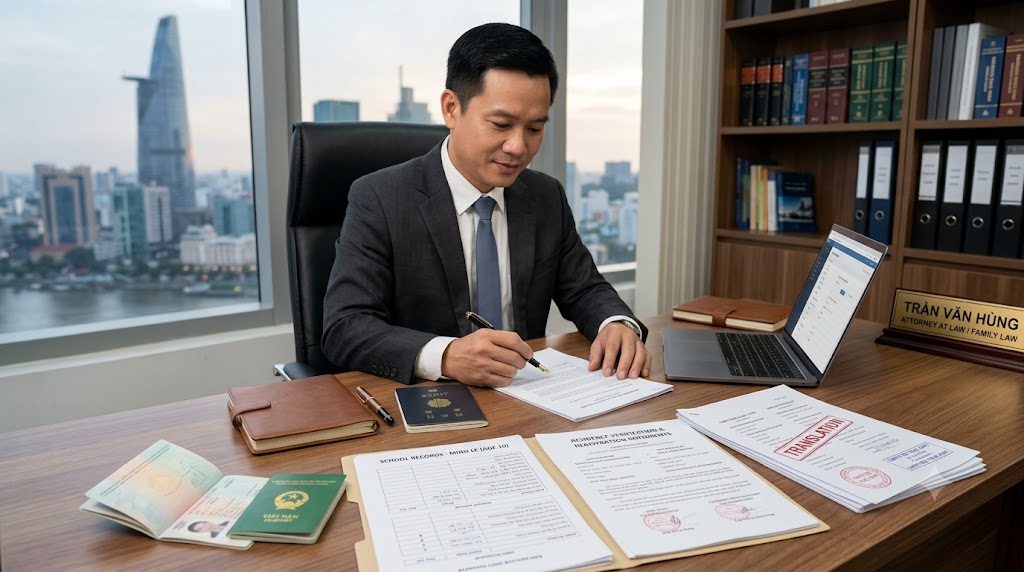
Consider a case where a Vietnamese court handles the divorce. Parent A is living in Vietnam and asks to directly raise the child. Parent B and the child are living overseas. The child is old enough for his or her wishes to be considered, and custody is disputed.
The first step is to review jurisdiction and the foreign elements of the case. The lawyer should check whether the Vietnamese court can handle the divorce and related custody issue, and whether the location of Parent B and the child creates procedural requirements.
The second step is to define the custody request clearly. Parent A should not only state that he or she wants to raise the child. Parent A should prepare evidence showing the proposed care plan, including housing, schooling, income, daily care, emotional support, and how contact with Parent B may be maintained.
The third step is to address overseas residence of the child. The case file should show where the child currently lives, whether the child is attending school, who is caring for the child, and whether the current arrangement of the child is temporary or stable.
The fourth step is to identify how the wishes of the child may be considered. Parent A should not simply submit an informal claim about what the child wants. Parent B should also not assume that keeping the child overseas prevents the court from considering custody. A proper method should be reviewed and, where necessary, raised with the court.
The fifth step is to prepare foreign documents correctly. School records, residence documents, communications, or documents related to the opinion of the child may need formal processing before they are submitted in Vietnam.
The sixth step is to remember that the wishes of the child are not the entire case. Even if the child says he or she wants to remain abroad with Parent B, Parent A may still present evidence on welfare of the child and the proposed care plan. Even if the child says he or she wants to live with Parent A in Vietnam, the court still needs to consider whether that arrangement is practical and in the interests of the child.
Parents facing similar issues may also review related guidance on child custody disputes with people living abroad.

Before filing a Vietnam divorce case where the child is living abroad, parents should take practical steps to avoid procedural problems later.
Confirm exact current residence of the child, including country, city, school, and living arrangement.
Check whether the Vietnamese court has jurisdiction over the divorce and custody issues.
Identify whether custody is agreed or disputed.
Confirm whether the wishes of the child need to be considered based on age and circumstances.
Discuss in advance how the opinion of the child may be obtained or verified while the child remains overseas.
Prepare evidence about care conditions of each parent, including housing, income, education plans, and daily care capacity.
Review foreign documents early to determine whether certification, legalization, translation, or other formal steps may be required.
Avoid pressuring the child to choose between parents.
Prepare a practical explanation if the child cannot conveniently return to Vietnam.
Seek legal advice before relying on informal statements or overseas documents.
These steps help the parent present the issue in a structured and realistic way. They also reduce the risk that the court will later require additional clarification, causing delay or uncertainty.

A Vietnam divorce case becomes more complex when the child is living abroad and the wishes of the child need to be considered. The issue may involve family law, court procedure, foreign documents, overseas residence evidence, translation, legalization, and practical communication between parents in different countries.
APOLO LAWYERS - Solicitors & Litigators can assist clients by reviewing jurisdiction and foreign elements, assessing custody issues, preparing divorce and custody documents, identifying evidence relating to a child living overseas, advising on procedural issues concerning documents or evidence from abroad, and representing or assisting clients in Vietnam where legally permitted.
If your divorce case is being handled in Vietnam but your child is currently living overseas, the case should be reviewed based on the current residence of the child, the country where the child is living, the status of the Vietnamese proceedings, the custody dispute, the available documents, and the method the court may require to consider the wishes of the child.

Address: 108 Tran Dinh Xu Street, Cau Ong Lanh Ward, Ho Chi Minh City, Vietnam
Tel: (+8428) 66.701.709 | (+84) 908.043.086
Email: contact@apolo.com.vn
Hotline: (+84) 903.600.347
Address: 9th/F, Tower K&M Building, 33 Ung Van Khiem St., Thanh My Tay Ward, HCM City, Vietnam
Tel: (+8428) 35.059.349 | (+84) 908.097.068
Email: contact@apolo.com.vn
Hotline: (+84) 979.48.98.79