
A foreign national seeking divorce in Vietnam may face questions that do not arise in an ordinary domestic divorce. Where can the divorce be filed? Does a Vietnamese court have jurisdiction if the marriage was registered overseas? What happens if one spouse lives in another country? Will a Vietnamese divorce judgment be recognized abroad?
These questions should be addressed before an application is submitted. The nationality of the spouses, their residence, the location of their children and property, and the legal status of their marriage may all affect the appropriate procedure.
Divorce in Vietnam for foreigners is possible where the case falls within Vietnamese jurisdiction and the applicable legal requirements are satisfied. However, not every marriage involving a Vietnamese citizen or a foreign national can automatically be dissolved through the Vietnamese courts.
This guide explains the main legal principles, procedures and documentation requirements for international divorce matters in Vietnam.
Can Foreigners Get Divorced in Vietnam?
Vietnamese law recognizes divorce proceedings involving foreign elements, including marriages between Vietnamese citizens and foreign nationals and certain marriages between foreign nationals.
Common situations include:
-
A foreign national married to a Vietnamese citizen, with both spouses residing in Vietnam.
-
A Vietnamese citizen seeking divorce from a foreign spouse who lives overseas.
-
Two foreign nationals with a legally relevant residence connection to Vietnam.
-
A marriage registered outside Vietnam where one spouse seeks divorce before a Vietnamese court.
-
An international family with children or marital assets in more than one country.
The availability of Vietnamese divorce proceedings depends on the circumstances of each case.
For example, a foreign citizen living in Vietnam with a Vietnamese spouse may have a different jurisdictional position from a couple who married in Vietnam but have subsequently established their permanent lives overseas.
Likewise, two foreign nationals who are temporarily visiting Vietnam should not assume that they can obtain a Vietnamese divorce merely because they are physically present in the country.
The first question is therefore not simply whether foreigners are allowed to divorce in Vietnam. It is whether the relevant Vietnamese court has legal authority to consider the particular divorce.
When Do Vietnamese Courts Have Jurisdiction Over International Divorce?
The jurisdictional framework for foreign-related divorce cases is principally established by the Law on Marriage and Family 2014 and the Civil Procedure Code 2015, as amended.
Article 127 of the Law on Marriage and Family addresses divorce involving foreign elements. Articles 469 and 470 of the Civil Procedure Code establish important rules concerning international jurisdiction.
A proper jurisdictional assessment must distinguish four different questions.
International jurisdiction
International jurisdiction concerns whether the Vietnamese court system may hear the dispute at all.
Relevant connecting factors may include the parties' nationality, residence, the respondent's connection to Vietnam and the specific grounds established under Vietnamese procedural law.
Article 469 of the Civil Procedure Code contains general provisions concerning the jurisdiction of Vietnamese courts over civil matters involving foreign elements.
Article 470 addresses matters falling within the exclusive jurisdiction of Vietnamese courts.
These provisions must be examined in their applicable amended form and in the context of the particular facts.
Not every international divorce falls within Vietnam's exclusive jurisdiction, and not every connection with Vietnam establishes jurisdiction.
Subject-matter jurisdiction
Once international jurisdiction has been established, the next question is whether the requested relief belongs to the relevant category of matrimonial and family proceedings.
For example, a dispute involving divorce, child custody, maintenance and division of marital property may raise different procedural questions from a request solely for recognition of a consensual divorce.
The precise claims should be identified before selecting the procedural route.
Court-level jurisdiction
Vietnam introduced important reforms to its court organization and procedural jurisdiction in 2025.
Consequently, older explanations that automatically assign foreign-related divorce cases to provincial-level courts or refer clients to district-level courts may no longer accurately describe the current framework.
The competent first-instance court must be identified under the court organization and civil procedure rules in force when the application is made, including the provisions concerning Regional People's Courts.
Foreign nationality alone should not be used as a shortcut for determining the court level.
Territorial jurisdiction
Territorial jurisdiction determines which particular court is competent to handle the matter.
Relevant factors may include the respondent's residence, any legally relevant agreement between the parties and the applicable procedural rules for the type of divorce requested.
A person living in Ho Chi Minh City should not automatically assume that every Vietnamese court located in the city can accept the application.
Jurisdiction should be established before documents are filed or court fees are paid.
Which Country's Law Applies to Divorce in Vietnam?
Jurisdiction and applicable law are different legal questions.
A Vietnamese court may have jurisdiction to hear a divorce, but the rules determining which country's substantive law applies can require a separate analysis.
Article 127 of the Law on Marriage and Family 2014 contains important provisions governing international divorce.
In certain circumstances involving a Vietnamese citizen who does not permanently reside in Vietnam at the time of the divorce request, the law of the spouses' common place of permanent residence may become relevant.
Where the spouses do not have a common place of permanent residence, Vietnamese law may apply under the statutory framework.
The treatment of immovable property located overseas also requires particular attention to the law of the country where that property is situated.
For example, a couple may have a marriage connected to Vietnam but own a home in another country. The divorce itself and the legal treatment of that overseas property should not automatically be assumed to be governed by identical rules.
International treaties and other applicable conflict-of-law provisions may also affect the analysis.
Mutual Consent Divorce and Unilateral Divorce in Vietnam
Vietnamese law provides different legal mechanisms depending on whether both spouses agree to divorce.
Divorce by mutual consent
Article 55 of the Law on Marriage and Family 2014 governs divorce by mutual consent.
The court considers whether both spouses genuinely and voluntarily agree to terminate the marriage and whether arrangements concerning children and property meet the relevant legal requirements.
Where the parties have reached appropriate agreements protecting their lawful interests and those of their children, the court may recognize the divorce under the applicable procedure.
However, agreement between the spouses does not remove the need to establish Vietnamese jurisdiction or comply with procedural formalities.
For international couples, documentation, overseas residence and participation requirements may still complicate an otherwise uncontested divorce.
Unilateral divorce
Article 56 addresses divorce requested by one spouse.
Where the other spouse does not agree, the applicant must establish the applicable statutory grounds.
These may involve serious violations of marital rights and obligations, domestic violence, or circumstances demonstrating that the marital relationship has seriously deteriorated and the purposes of marriage can no longer be achieved.
A spouse's refusal to sign divorce documents does not automatically prevent the other party from filing.
Nevertheless, the court must consider the evidence and legal requirements rather than granting divorce solely because one spouse requests it.
Restrictions on the right to request divorce
Article 51 of the Law on Marriage and Family contains an important restriction on a husband's right to request divorce in specified circumstances involving pregnancy, childbirth and the care of a child under 12 months old.
The restriction must be considered according to the statutory language and the facts of the case.
It should not be misinterpreted as a general prohibition on all divorce proceedings during pregnancy or following childbirth.
What Documents Are Required for Divorce in Vietnam?
The required divorce documents in Vietnam depend on the type of proceeding, the parties' circumstances and whether children or property disputes are involved.
There is no universal checklist suitable for every international divorce.
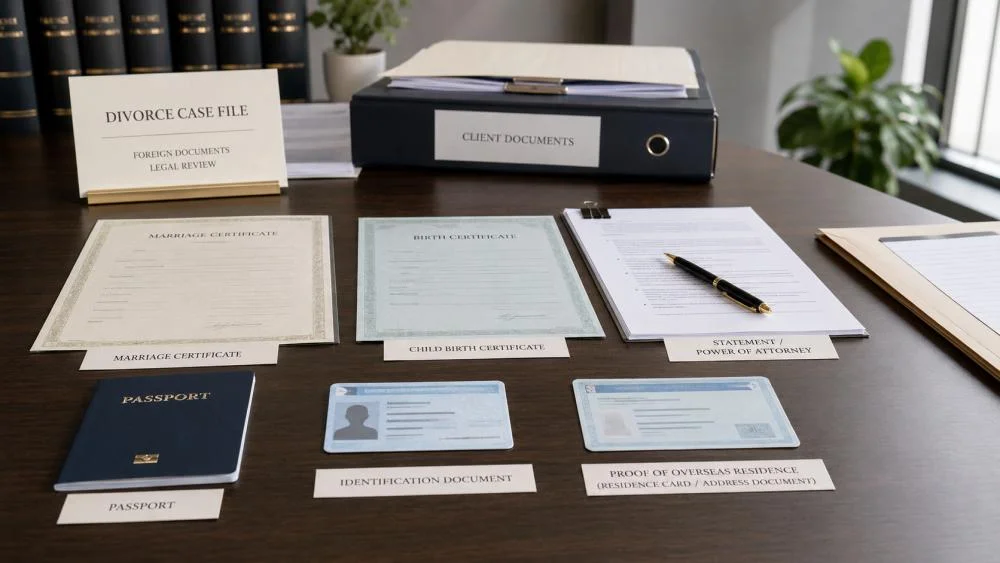
Practical divorce document checklist
- Divorce petition or mutual consent application appropriate to the proceedings.
-
Marriage certificate or other acceptable evidence of the marriage.
-
Passport or identification documents for the foreign spouse.
-
Relevant identification documents for the Vietnamese spouse, where applicable.
-
Information or records establishing each spouse's current residence or address.
-
Children's birth certificates, if the marriage involves children whose interests are relevant to the proceedings.
-
Evidence relating to childcare, education, living arrangements and financial circumstances, where necessary.
-
Documents concerning marital assets, property interests and liabilities, where division is requested.
-
Evidence supporting the statutory grounds for unilateral divorce.
-
Appropriately legalized or exempted foreign-issued documents, with compliant Vietnamese translations where required.
-
Authorization documents for procedural activities where representation is legally permitted.
Some cases require substantially fewer documents. Others require additional evidence, particularly where one spouse lives abroad or the parties dispute property ownership.
Marriage certificates issued outside Vietnam
A marriage registered overseas may be relevant to Vietnamese divorce proceedings, provided the legal requirements concerning the marriage and supporting documentation are satisfied.
The court may need to determine whether the foreign marriage has an appropriate legal status under the applicable Vietnamese rules.
Depending on the circumstances, civil-status recording procedures or additional documents may be relevant.
A foreign marriage certificate should not simply be assumed invalid because it was issued outside Vietnam. Equally, its existence does not automatically establish Vietnamese court jurisdiction.
Consular legalization and translation
Foreign-issued records submitted in Vietnamese legal proceedings may require consular legalization unless an applicable treaty or legally recognized exemption provides otherwise.
The precise process depends on the issuing country, document type and purpose of use.
Foreign-language documents may also need Vietnamese translations prepared and certified in accordance with the applicable procedural requirements.
Common examples include foreign marriage certificates, birth certificates, residence records and official identification or civil-status documents.
Clients should confirm the required formalities before arranging international shipment of originals.
Missing or unavailable documents
Where an original marriage certificate or other record is unavailable, a certified extract, replacement certificate or other legally acceptable documentation may be obtainable.
The appropriate solution depends on the authority that issued the original record and the evidentiary requirements of the Vietnamese proceeding.
Missing documents should be identified early because they may affect the court's ability to examine or accept the application.
What Is the Divorce Procedure in Vietnam?
Although the divorce procedure in Vietnam varies according to the case, several general stages commonly arise.
Step 1 Determine jurisdiction and the appropriate procedure
The parties' nationality, residence, marriage records and requested relief should be reviewed to establish whether Vietnamese courts have jurisdiction.
The competent court must then be identified under the current procedural and court organization rules.
It is also necessary to determine whether the matter should proceed as a mutual consent request or a contested divorce case.
Step 2 Prepare the application and supporting documents
The application should accurately identify the spouses, marriage and requests made to the court.
Where children or assets are involved, the relevant claims and available evidence should be organized.
Foreign-issued documentation should be checked for legalization, translation and certification requirements.
Step 3 Submit the application
The documents are submitted through a procedurally accepted method to the competent court.
The court examines the materials and may require clarification, correction or supplementation.
Submission alone does not necessarily mean that a case has been formally accepted for examination.
Step 4 Complete applicable court payment requirements
Depending on the procedural classification, the applicant may be required to pay an advance court fee or charge.
The applicable rules distinguish between different types of civil and family proceedings and may also take property-value disputes into account.
Step 5 Participate in court procedures
The court may conduct legally prescribed procedures concerning evidence, conciliation, the parties' statements and contested issues.
The precise sequence differs between mutual consent and unilateral divorce.
Where a spouse resides overseas, international notification and participation requirements may affect this stage.
Step 6 Obtain the legally effective court documentation
Where the legal conditions are satisfied, the proceedings may conclude with the appropriate court decision or judgment.
The parties should establish when that decision or judgment takes legal effect and whether additional documentation is needed for civil-status updates or use abroad.
The existence of a Vietnamese divorce judgment does not necessarily establish automatic recognition in another country.
How Are Child Custody and Child Support Decided?
International divorce cases involving children require careful attention to the children's legal rights, living arrangements and future welfare.
Child custody
Article 81 of the Law on Marriage and Family 2014 addresses the care and raising of children after divorce.
Parents may agree on arrangements for their children where those arrangements satisfy the applicable legal conditions.
Where agreement is not possible, the court considers the interests of the child and the relevant circumstances.
The law includes specific rules concerning consideration of the wishes of children aged seven or older and the direct care of children under 36 months old.
These provisions must be applied with their statutory qualifications rather than treated as automatic custody rules in every case.
Can a foreign parent obtain custody?
A parent's foreign nationality is not, by itself, an automatic disqualification from directly raising a child.
The court considers the applicable legal criteria and the circumstances affecting the child's welfare.
Where a proposed custody arrangement involves relocation abroad, questions concerning the child's residence, travel documents and international recognition may arise.
A custody arrangement approved in Vietnam should not be assumed to resolve all requirements imposed by another country.
Child support and visitation
Articles 82 and 83 address rights and obligations of parents who do not directly raise their children, including maintenance and visitation.
The amount and manner of support may depend on the child's needs, the responsible parent's financial circumstances and other legally relevant considerations.
Cross-border support can introduce separate enforcement difficulties, especially where the responsible parent and their assets are located abroad.
How Is Marital Property Divided in International Divorce?
The division of marital property may become particularly difficult where spouses own assets in several countries.
Vietnamese law distinguishes between common marital property and separate property under the applicable matrimonial property regime.
Article 59 of the Law on Marriage and Family 2014 contains important principles for dividing common marital property where the statutory property regime applies.
Marital property in Vietnam
Assets may include bank accounts, business interests, vehicles, permitted real estate interests and other lawfully held property.
The legal status of each asset must be examined.
Foreign nationals may face special restrictions concerning land-use rights or certain forms of property ownership in Vietnam.
A divorce judgment should not be assumed to create ownership rights that Vietnamese law otherwise prohibits.
Property located overseas
Property outside Vietnam requires separate legal consideration.
Questions may arise concerning the applicable law, the Vietnamese court's jurisdiction, evidence of ownership, valuation and enforcement abroad.
Article 127 specifically addresses the law applicable to immovable property located overseas in international divorce matters.
The legal treatment of an overseas home may therefore differ from the treatment of assets located in Vietnam.
Joint debts and financial obligations
Divorce does not automatically eliminate lawful debts owed to third parties.
The parties may need to identify when obligations arose, their purposes and whether they are legally attributable to one spouse or both.
International loans, overseas accounts and foreign business interests may require additional documentary and legal analysis.
What Happens When One Spouse Lives Outside Vietnam?
A spouse's overseas residence may affect both jurisdiction and procedure.
Courts may need reliable information concerning the overseas spouse's address and a legally appropriate method of serving judicial documents.
Depending on the circumstances, the proceeding may involve international judicial assistance, overseas notifications or other procedures prescribed by law.
Practical difficulties commonly arise when:
-
The overseas spouse's address is unknown or disputed.
-
The respondent refuses to cooperate.
-
Documents must be obtained from foreign authorities.
-
One spouse cannot travel to Vietnam.
-
Related proceedings have been commenced in another jurisdiction.
These difficulties do not necessarily make divorce impossible, but they may affect how the proceedings can lawfully continue.
Can divorce proceed without a spouse travelling to Vietnam?
In certain circumstances, a court may proceed without a party attending every procedural event in person, provided the relevant legal conditions are satisfied.
However, absence from court and representation by another person are separate legal issues.
Vietnamese procedure includes special restrictions concerning authorization in divorce matters.
A foreign spouse should therefore not assume that signing a power of attorney is sufficient to transfer all personal procedural responsibilities to a lawyer or relative.
The exact requirements depend on the proceeding and the circumstances of the party concerned.

What Are the Court Fees and Expected Timelines?
There is no single cost or completion period applicable to every foreign divorce in Vietnam.
Statutory court fees and charges
Court fees and charges are determined under the applicable legal schedules.
The classification of the proceeding and the presence of property-value disputes may affect the payment required.
Relevant expenses may also include document translation, legalization, international delivery, judicial assistance, asset valuation and legal representation.
Professional fees are separate from statutory court payments and depend on the agreed scope of services.
How long does an international divorce take?
Procedural periods are governed by the applicable legislation, but actual progress depends on the nature of the case.
An uncontested matter involving cooperative parties and complete documents may require fewer contested procedural steps than a case involving overseas notification, disputed custody or complex international assets.
The need to obtain foreign documents, correct filings, arrange lawful service or examine additional evidence may affect the overall duration.
A reliable timeline should therefore be assessed against the particular case rather than offered as a guaranteed processing period.
When Should Foreigners Seek Legal Assistance?
Professional legal advice may be particularly useful before filing where the case involves uncertain jurisdiction, an overseas spouse, a foreign-registered marriage, international custody concerns or substantial property in different countries.
Legal assistance may include:
-
Reviewing the parties' nationality, residence and marriage documentation.
-
Assessing jurisdiction and the potentially applicable law.
-
Identifying the appropriate procedural route.
-
Reviewing foreign documents and relevant formalities.
-
Preparing or reviewing divorce applications and evidence.
-
Assessing proposed custody, maintenance and property arrangements.
-
Assisting with court procedures or representation where legally permissible.
-
Identifying recognition or enforcement issues requiring advice in another jurisdiction.
For foreign clients, early assessment may be especially important before commencing parallel proceedings in different countries or making significant decisions concerning children's residence.
Conclusion
Divorce in Vietnam for foreigners requires a careful assessment of jurisdiction, applicable law, supporting documents and the circumstances of both spouses.
The legal process may be relatively straightforward where jurisdiction is clear, the parties cooperate and the documentation is complete. Other cases involve significant questions concerning overseas residence, child custody, foreign assets or the recognition of court decisions abroad.
Understanding these distinctions before filing can help international families identify the appropriate legal options and avoid unnecessary procedural difficulties.
The correct approach must ultimately be determined from the relevant facts and documents of the individual case.


