Contact Center
+84 903419479
Contact Center
+84 903419479
Divorce Counseling 16/10/2026
Divorce in Vietnam generally follows one of two procedural routes: consensual divorce or unilateral divorce.
The distinction matters from the beginning. In a consensual divorce, both spouses agree to end the marriage and can reach the necessary arrangements concerning children, financial obligations and other relevant issues. In a unilateral divorce, one spouse asks the court to dissolve the marriage without complete agreement or cooperation from the other spouse.
For foreign clients, the procedure can become more complicated when one spouse lives overseas, documents were issued abroad, children reside in another country or the spouses have assets in more than one jurisdiction.
Understanding which route applies is therefore the first practical step before preparing a divorce filing in Vietnam.
A consensual divorce is based on both spouses voluntarily agreeing to terminate the marriage and reaching acceptable arrangements on the consequences of divorce.
A unilateral divorce is initiated by one spouse where that level of agreement does not exist. This commonly arises when the other spouse opposes the divorce, refuses to sign documents, stops cooperating or disputes issues such as children or property.
The main differences can be understood as follows:
Both spouses agree to divorce.
The procedure is based on a joint request and mutual consent.
The court considers whether the divorce is voluntary and whether the spouses have reached acceptable arrangements on relevant matters.
The procedure is generally more cooperative, although it is not necessarily simple.
Substantial cooperation from both spouses is normally required.
Full agreement between the spouses is not required.
One spouse files the divorce case against the other.
The court considers the legal basis for divorce as well as any disputed issues.
The proceedings are often more evidence intensive where the parties disagree.
The case can proceed despite a lack of full cooperation, subject to applicable procedural requirements.
The practical difference is not simply whether both spouses say they want a divorce. The court process can also depend on whether they agree on children, support, property and debts, and whether both are willing and able to participate in the proceedings.

Consensual divorce in Vietnam is generally appropriate where both spouses voluntarily agree to end the marriage and can reach legally acceptable arrangements on the matters that need to be resolved.
Those matters commonly include:
agreement to terminate the marriage;
who will directly care for the children after divorce;
child support where applicable;
treatment of marital property;
responsibility for common debts or financial obligations.
The spouses prepare the appropriate application and supporting documents and file them with the competent court. The court then reviews the request, the voluntary nature of the agreement and the arrangements reached by the parties.
The procedure is cooperative, but cooperation does not remove every legal or procedural issue. For example, the court may still require clarification or additional documents where one spouse lives overseas, a marriage certificate was issued abroad, children live in another country or property arrangements are not sufficiently clear.
A case can therefore be consensual without being administratively straightforward.
Readers who need the step-by-step details of this route can review the separate guide to consensual divorce procedures in Vietnam.
Unilateral divorce becomes relevant when one spouse wants to end the marriage but the other spouse does not fully agree or cooperate.
Typical situations include where the other spouse:
refuses to agree to the divorce;
refuses to sign a joint application;
stops responding to communications;
does not voluntarily participate in the procedure;
disputes children, support, property or debts.
The spouse seeking divorce files a petition with the competent Vietnamese court together with the documents and evidence supporting the request.
Before the substantive dispute is considered, the filing must first satisfy jurisdictional and procedural requirements. Once the case is accepted, the court process may involve the submission and disclosure of evidence, procedural meetings, mediation where applicable and hearings or other court proceedings required by the case.
A spouse’s refusal to sign divorce papers does not, by itself, prevent the other spouse from seeking a divorce. At the same time, unilateral divorce should not be understood as a procedure in which the applicant only needs to express a wish to leave the marriage. The court must consider whether the statutory requirements for granting a unilateral divorce are satisfied on the facts and evidence before it.
Where children, financial support, property or debts are disputed, those issues can also affect the scope of evidence and the complexity of the proceedings.
For a detailed explanation of this route, see unilateral divorce procedures in Vietnam.
The exact divorce dossier depends on the facts of the case. A divorce involving two spouses living in Vietnam will not necessarily require the same preparation as a case involving a foreign spouse living overseas.
Common document groups include:
marriage certificate;
passports, identity cards or other identification documents;
documents or information concerning residence;
children’s birth certificates where applicable;
documents relating to property where property issues are relevant;
evidence of common debts or financial obligations;
evidence supporting claims made in a unilateral divorce;
foreign-issued documents relevant to the marriage, identity or residence of the parties.
Foreign documents require particular attention. Depending on the document, the issuing country and any applicable treaty, exemption or procedural rule, additional authentication, consular legalization, certification or Vietnamese translation may be necessary.
For that reason, foreign documents should be reviewed before the divorce application is finalized rather than after the court has raised an issue with the dossier.
A broader discussion of these issues is available in the guide to divorce in Vietnam for foreigners.

Identifying the correct Vietnam divorce court should be done before filing, not after the application has been prepared.
Jurisdiction can depend on factors such as:
where the spouses reside or are domiciled;
whether either spouse is a foreign national;
whether one spouse lives outside Vietnam;
whether the case has another foreign element;
whether property disputes form part of the proceedings;
the location and nature of relevant assets;
other rules under Vietnamese procedural law.
In practice, jurisdiction affects both the level of court and the particular court to which the case should be submitted. A divorce involving a spouse who resides abroad can therefore follow a different jurisdictional path from an otherwise similar domestic case.
Filing with a court that does not have jurisdiction can result in the dossier being returned, transferred or otherwise delayed by jurisdictional issues before the divorce itself is considered.
Foreign spouses and overseas Vietnamese should therefore confirm jurisdiction at the beginning of the case, especially where current residence, overseas addresses or cross-border property create uncertainty.
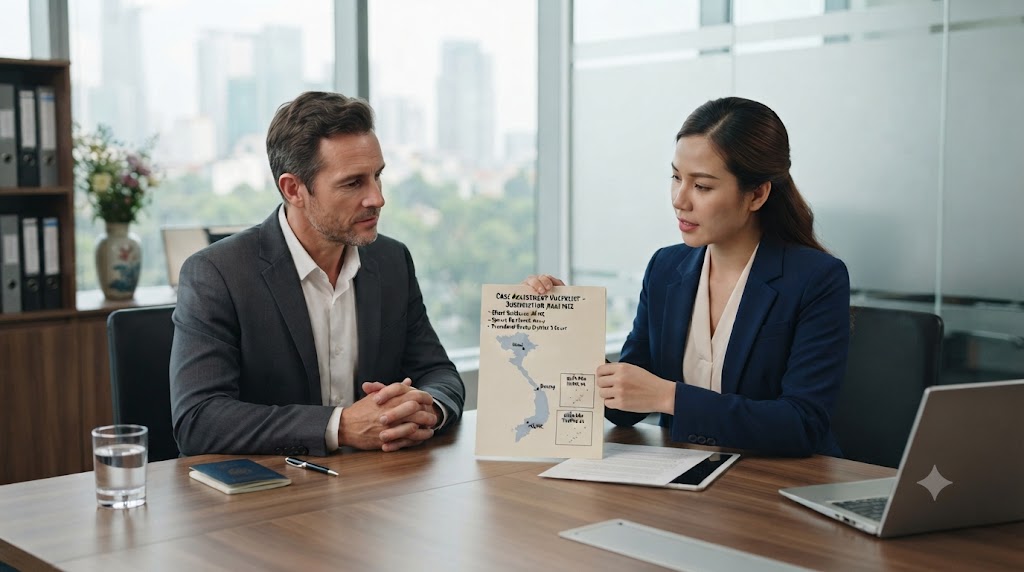
Children can change the procedure from a relatively focused divorce filing into a case requiring substantially more evidence and court consideration.
Where parents agree on who will directly care for a child and on child support, the court can consider their agreement as part of the divorce process, subject to the applicable legal requirements and the child’s lawful interests.
Where they disagree, each parent may need to provide evidence relevant to the proposed care arrangement and the child’s circumstances.
Cross-border cases add another practical layer. If a parent or child lives overseas, questions can arise about residence information, evidence from abroad, participation in the proceedings and how proposed parenting arrangements will work in practice.
For procedural planning, these issues should be identified before filing rather than treated as separate questions to resolve later.

Property disputes can significantly expand the scope of a divorce case.
Where spouses have already agreed on their property or do not ask the divorce court to resolve certain assets, the procedure may remain more focused. Where ownership, classification or division of property is disputed, the court may need much more extensive evidence.
That evidence can concern:
who legally owns an asset;
when and how it was acquired;
the source of funds used to acquire it;
each spouse’s contribution;
outstanding loans or other financial obligations;
the legal status of business interests or real estate.
The procedural impact can be substantial when the assets include real estate, company interests, bank assets or property located in more than one country. Valuation, supporting records and cross-border legal questions can all become relevant.
There is no reliable basis for assuming that every marital asset will be divided according to a fixed percentage. Property issues must be assessed against the specific facts, claims and evidence of the case.

A foreign-element divorce often requires more procedural preparation than a purely domestic case.
One of the first issues is the location of the other spouse. If a spouse is outside Vietnam, the court may require accurate overseas address information and additional procedural steps for the delivery or service of court documents.
Other practical issues can include:
foreign-language documents;
civil status records issued by foreign authorities;
difficulty locating a spouse abroad;
a spouse who does not respond to court communications;
assets situated in Vietnam and another country;
children living outside Vietnam;
evidence that must be obtained overseas;
related family or property proceedings in another jurisdiction.
These issues do not automatically prevent a Vietnamese divorce. They do, however, affect how the case should be prepared.
For example, a client may have a clear basis to start proceedings in Vietnam but still encounter difficulty because the respondent’s current overseas address cannot be confirmed. In another case, the divorce itself may be relatively straightforward while a property dispute involving assets abroad requires separate analysis.
The international element should therefore be mapped out at the beginning of the case.

The most useful way to distinguish the two procedures is to look at the actual level of agreement and cooperation between the spouses.
both spouses agree that the marriage should end;
both are willing to participate in the procedure;
they can reach acceptable arrangements concerning children where applicable;
they have resolved relevant property and debt issues or agreed how those matters will be handled;
both are willing to sign and provide the necessary documents.
one spouse refuses to divorce;
one spouse will not sign a joint application;
the spouses cannot reach agreement on fundamental issues;
one spouse has stopped cooperating;
one spouse is absent or overseas and does not participate voluntarily.
The classification depends on the substance of the case.
Two spouses may both want a divorce but still be unable to use the consensual route because they cannot resolve major issues. Conversely, a case that begins as contested can become more cooperative as the parties clarify their positions.
Neither route is automatically better or faster. The appropriate procedure depends on the level of agreement, issues in dispute, available evidence and any foreign elements affecting the case.

For foreign clients, the main difficulty is often not understanding that divorce is possible, but identifying the correct procedure and preparing the case properly from the start.
APOLO LAWYERS - Solicitors & Litigators can assist with:
assessing whether the case is consensual or unilateral;
reviewing Vietnamese court jurisdiction;
preparing or reviewing divorce applications and supporting documents;
advising on foreign-issued documents and overseas parties;
addressing procedural issues involving children, property and debts;
representation or procedural assistance where legally permitted.
Foreign-element divorce cases can differ significantly depending on residence, nationality, cooperation between the spouses, children, property and the documents available.
Clients who need advice based on their particular circumstances can contact Apolo Lawyers.

Potentially, yes. Vietnamese law provides a unilateral divorce procedure that does not require the other spouse’s consent. The court will still examine whether the applicable legal requirements are satisfied based on the circumstances and evidence of the case.
Foreigners may be able to participate in divorce proceedings before a Vietnamese court where the case falls within Vietnamese jurisdiction. Jurisdiction should be checked based on the parties’ nationality, residence, the location of the other spouse and other relevant connections with Vietnam.
Living outside Vietnam does not automatically prevent a consensual divorce. However, overseas residence can affect jurisdiction, document preparation and how the parties participate in the court procedure.
If one spouse refuses to sign a consensual divorce application, the matter generally cannot continue as a joint request based on mutual consent. The spouse seeking divorce may need to consider whether unilateral divorce proceedings are appropriate.
Not every divorce follows the same procedural approach. Spouses may be able to agree on certain matters separately, while disputed issues concerning children, support, property or debts may require court determination. The appropriate structure depends on the claims and circumstances of the individual case.
Address: 108 Tran Dinh Xu Street, Cau Ong Lanh Ward, Ho Chi Minh City, Vietnam
Tel: (+8428) 66.701.709 | (+84) 908.043.086
Email: contact@apolo.com.vn
Hotline: (+84) 903.600.347
Address: 9th/F, Tower K&M Building, 33 Ung Van Khiem St., Thanh My Tay Ward, HCM City, Vietnam
Tel: (+8428) 35.059.349 | (+84) 908.097.068
Email: contact@apolo.com.vn
Hotline: (+84) 979.48.98.79